Home Page › Forums › Forum Area › Cultivation Area › Incubation › Incubation room
Tagged: HUmity in incubation..
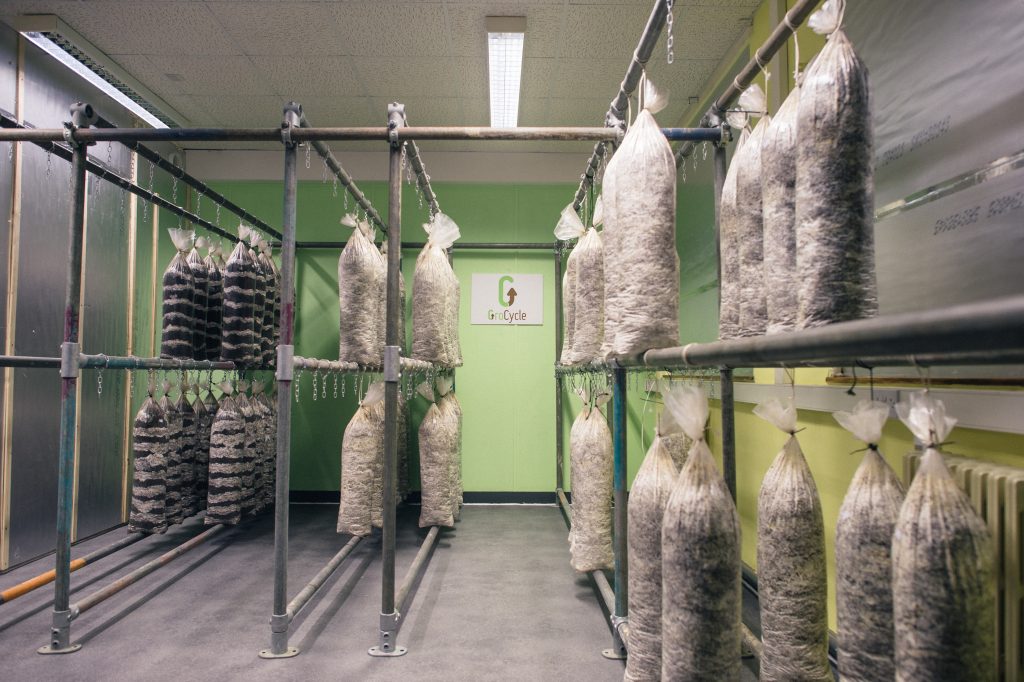
Hi guys, can you show me a photo of your incubation room. Is it basically a warm dark room? The fruiting room need to be humid but bit the incubation room right?
Thanks
Jonny
Hi Jonny,
Yes, an incubation room can be very simple – it is just a warm (20-24C), dark space where the mycelium can be left to colonise the substrate. Here’s a photo from inside our incubation room:

As you can see it is just an insulated room (the lights are normally kept off).
Hope this helps, Adam
Is the advantage of incubating in the dark more control around when you want them to fruit e.g less pinning etc. Are they more likely to fruit around the cut hole in the bag then random pinning throughout the bag.
Many thanks as always
Jonny
Hi, I notice in your photo that the bags on the far left look have the mycelium seems to be developing in layers? It looks great and is developing super even which is certainly not how mine look. Have you changed your method of mixing your spawn in?
Jonny – yes incubation in the dark is not super important, but it means you can hold your bags off from fruiting a little longer as the light is a trigger to start pinning. However, some strains will still fruit in the dark as soon as the substrate is fully colonised so it’s not a way to prevent fruiting for sure, and certainly not for any length of time.
The fruiting from the holes depends a bit on the strain used, but most strains will fruit from around where you cut the holes as they sense higher oxygen levels there and grow out into the space..it’s similar to how a mushroom would grow out of a crack in the wood of a log in the wild.
Leisha – yes we started spawning in layers like this in ouir bigger column bags and it works really well. We still mix the spawn in evenly when using smaller bags as it’s easier to do in bulk, but the layering is certainly worth it when inoculating larger amounts of substrate.
Hi,
I have noticed in the picture that you’re using very large size bags. How much substrate they hold? Is the “recipe” percentage for the substrate different than smaller size bags (ex: increase straw content to prevent the bags from becoming too compact)?
I’m not sure if I missed the info in the modules but I haven’t seen anywhere when exactly do you make the holes in the bags, how large they are and how many holes per bag.
Thank you,
Mirela
Hi Mirela and welcome to the course đŸ™‚
The bags we use hold around 12kgs of substrate and yes we do add more straw (30% of coffee weight) to reduce compaction in the larger substrate mix.
The info on when/how to cut holes in the bags was embarrassingly missed out when we first made the course and is due to be fixed in the new course update coming in a few weeks’ time.
The best place to make the holes is directly where the white colonised substrate is. If you are using small bags, you may be best with just one cut approx 5cm x 5cm on one side of the bag. If you are using larger bags you could cut more holes of the same size but space them apart by 10-15 cms around the bag. You can cut an X shaped hole with clean scissors or a sharp knife.
The best time to cut the holes will be slightly different for each Oyster mushroom strain, but in general you should aim to cut the holes just after the bag has fully colonised. It tends to be around 3-4 weeks after inoculation, and will be when the mycelium becomes bright white. If you start to see tiny pins forming inside the bag, you will know it is a couple days later than the ideal time, but still ok to open and fruit if the pins are only small.
Hope this helps.
best wishes, Adam

In incubation room, is humity important??
I refer to external moisture the bag(microperfurated or unicorn)
Thanks..
1- In incubation room, is humity important??
I refer to external moisture the bag(microperfurated or unicorn)
you can talk about the difference in the passage of incubation for fruiting of different types of pleorutus?
Thanks..
Hi Gabriel,
humudity levels are not so important in the space where you incubate your bags as the bag seals in the moisture in your substrate and prevents it from drying out.
best wishes,
Adam
Hi Adam, is the reason you use the steal frames for hygiene ? Would timber be inappropriate ?
Thanks K
Hi Keith,
Timber is fine in an incubation space – we just use the steel frames because they’re the best way of hanging the larger column bags but wooden or plastic shelves are also fine in incubation space. For fruiting space, timber is not so good as it tends to rot in the high humiddity, so plastic or stainless steel is preferable there.
best wishes, Adam