
Menu
Assign a 'primary' menu
 Adam
AdamHi Andrew,
good to hear your mycelium has been taking off well. 28C is probably a bit of the hot side though, but it depends a bit on what strain you are using. If it is a warm weatehr strain, it may tolerate this a little better than cooler weatehr strains.
The sweating inside the bag is probably a side effect of the high heat, which will increase the metabolisism of the mycelium. What grow bags are you using?
If you were able to increase the air exchange with a few small holes poked in the bag this would help some of the water vapour to evaporate out of the bag. You may also want to poke a couple of holes in the bottom of the bag and hang it up so any excess water can drain out, instead of pooling at the bottom where it may suffocate the mycelium.
It could also be a sign that the substrate water content was a little too high to begin with, so worth keeping an eye on this as well for future bags.
best wishes, Adam
AdamHi Josue,
welcome to the course and to the forum!
We just clean our bucket containers first with a cloth to get rid of any obvious dirt/coffee remains, and then with a weak bleach solution (10% bleach; 90% water) or sometimes with isoproanyl alcohol to keep them clean. We then put biodegradable bags inside the buckets as this reduces the amount of cleaning afterwards, but adding bags inside is certainly not essential. We used to just use buckets and clean them well each time + a light spray with bleach solution or alcohol.
best wishes, Adam
AdamIt depends on the particle size mostly, but tends to be around 60-65%.
You can test by squeezing a handful – if more than a few drops of water come out, it is oversaturated.
AdamHi Gabriel,
humudity levels are not so important in the space where you incubate your bags as the bag seals in the moisture in your substrate and prevents it from drying out.
best wishes,
Adam
AdamNice to hear you’ve found a use for some of your waste ‘straw soup’! A fe wyears back, when we were growing in a more rural location, we used to compost all the spent substrate ourselves and were amazed by how many worms turned up in it – they seemed to really love the stuff! Turned it into lovely rich and thick worm castings 🙂
AdamHi Kevin,
as we are based in an inner city building, our options for making use of the lime-bath water are a bit limited so it just goes in with the rest of the building’s grey and waste water. I have read that lime is often used in the early stages of water treatment works, probably for the same reason that the high pH prevents most biological organisms from growing.
The bags go into a plastics recycling scheme and the other main waste product is the spent growing substrate, which goes to the building’s waste collection company who run a commercial composting system.
Best of luck with your first bags – just get in touch if you have any questions along the way and let us know how they go… it’s always nice to see other people’s growing adventures 🙂
AdamHi Gabriel,
The ideal substrate pH is between 5 – 6.5, though mycelium can survive between pH 4 and 7.5. The pH level in the substrate should ideally be around 6 – 6.5 at the start and then it will drop during the incubation and fruiting stage as the mycelium utilises nutrients in the substrate. After 2 crops it will likley be below or around pH 5, and this is a good time to compost your bags as the mycelium is no longer at it’s strongest.
I don’t know with regards to a difference in pH of espresso or filter/cafetiere coffee but there is certainly a big difference in moisture content which can have a huge impact on your growing. Filter and cafetiere grounds tend to be too wet which can cause problems with poor air exchange and contamination in your bags. Espresso grounds are much better, especially when mixed with 20% straw to break up their density.
AdamHi Mirela,
was it the larger micro perforated bags that you were looking for? Here’s a link for those which we source from the Netherlands: http://www.eblaak.com/eng/materialen-en.asp
We mainly use these larger bags in our farm, and the smaller 10T and 3T Unicorn filter patch bags sometimes as well.
To clarify what Eric said regarding spawn rates – we used to use 15% a few years back when we were still experimenting with growing on coffee grounds. The higher rate increases chances of success which is why we would recommend starting higher and then reducing it once you have had some bags grow well and have got a feel for the process.
We are about to update all the course materials in the next couple of weeks and the ideal mix that we will teach will just be 3 ingredients:
– coffee grounds
– pasteurised straw (20% of coffee weight)
– spawn (10% of coffee weight)
This should give you good results with a substrate mix up to 3kg in each bag. If you grow with larger amounts per bag then you need to increase the straw to 30%.
It is best to get the process right in smaller bags and then move to larger bags later, as besides using the ideal mix there are lots of small things you will get an intuition about from watching how the mycelium behaves. This knowledge is useful when you grow in larger bags as you tend to encounter more problems and you then have a good idea of how you can rectify them.
Hope that makes sense – feel free to ask more if not.
best wishes, Adam
AdamThe ideal moisture level will depend alot on the exact substrate mix and in particular it’s saturation point (the maximum level of water it can hold before becoming saturated).
Straw has a high saturation point of around 72-74%, whereas coffee with it’s much smaller particle size can only hold around 55% water before becoming saturated.
Going beyond the saturation point is not good as you tend to get water collecting in the bag causing poor air exchange and increased contamination.
One of the downsides of growing on coffee is the low saturation point meaning that it doesn’t have so much water left in the substrate after the 1st flush. So – you can either soak your bags a day or so after the first flush and/or you can add more straw to the mix to bump up the overall moisture content of your substrate.
AdamHi Charlie,
great to hear of your trials, successes, and learnings. Thanks for sharing your photos too – really nice looking mushrooms!
The thing you mentioned about mushrooms growing in the top of the bags (instead of out of the holes you punched) sometimes happenas if humidity levels are slightly low outside the bag. The mushrooms choose to start fruiting in the more humid environment in the top of the bag.
If you fold the top of the bag over after punching the holes (so there is no space for them to grow inside the bag) you should find that they grow out of the holes you cut instead. This should give you a bigger yield and nice clusters which makes for easier picking.
Also, we’re about to update the course info in the next few weeks and one of the things that will be changed is to simplify the mix – so that there is no need to add the agricultural lime. We’ve found better results with just coffee, cold pasteurised straw and spawn.
When growing in those bigger bags you may also want to consider upping the straw to around 25% of coffee weight to reduce density and increase air exchange througout the bags.
Hoep this helps.
best wishes,
Adam
 Adam.
Adam
Adam.
AdamHi Mirela and welcome to the course 🙂
The bags we use hold around 12kgs of substrate and yes we do add more straw (30% of coffee weight) to reduce compaction in the larger substrate mix.
The info on when/how to cut holes in the bags was embarrassingly missed out when we first made the course and is due to be fixed in the new course update coming in a few weeks’ time.
The best place to make the holes is directly where the white colonised substrate is. If you are using small bags, you may be best with just one cut approx 5cm x 5cm on one side of the bag. If you are using larger bags you could cut more holes of the same size but space them apart by 10-15 cms around the bag. You can cut an X shaped hole with clean scissors or a sharp knife.
The best time to cut the holes will be slightly different for each Oyster mushroom strain, but in general you should aim to cut the holes just after the bag has fully colonised. It tends to be around 3-4 weeks after inoculation, and will be when the mycelium becomes bright white. If you start to see tiny pins forming inside the bag, you will know it is a couple days later than the ideal time, but still ok to open and fruit if the pins are only small.
Hope this helps.
best wishes, Adam
AdamHi Camilla,
what we have always done is to take a printed letter along when collecting and ask if the member of staff you speak to can pass it on to the manager. In this letter, just set out how often you would like to collect and what time of day you will come, what you need them to do etc. Ask in the letter if they can just notify all staff about the arrangement. Then just keep showing up on a regular basis and usually withiin a week or two it becomes established to the point that most/all cafe staff are aware of it and save the coffee for you.
You may have the odd occasion to begin with where you show up and someone had forgotten to save you the grounds, but this usually stops happening if you just keep going regularly.
Hope this helps.
best wishes, Adam
AdamHi Leisha,
Thanks for sending through the photo. Yes it can be hard to distinguish between the metabolites and bacterial infections – although the smell is probably the main indicator, and also the fact that the actual substrate itself becomes a bit yellowish/brown.
Worth cleaning out the greenhouse before you put any new bags in.
great to see you’ve been having some success with the fruiting as well though 🙂
best wishes,
Adam
AdamFor the benefit of others, Leisha emailed in:
——————
Hi Adam
Sorry wasn’t sure how to attach photos in the forum.
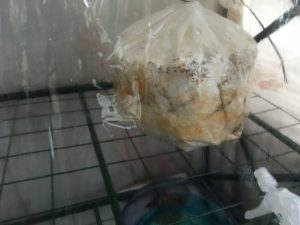
Here is the latest bag, the original one that was quite bad I had already tossed out. I thought the yellow was just that liquid waste metabolites you had mentioned in another forum post. To be honest though, I hadn’t washed out the greenhouse since the smelly bag and I have noticed that the temperature has been getting into the 20’s during the middle of the day in the greenhouse.
Cheers,
Leisha
AdamHi Leisha, it’s not normal for grow bags to smell but it can be a sign of a bacterial infection…this is often harder to spot visually than mould, but apart from the bad smell it also often turns part of the the substrate a brown/yellow-ish colour in places…are you able to post a photo so I can take a better look for you?