
Menu
Assign a 'primary' menu
 Adam
AdamJohn wrote:
——————–
I am using small bags which in the past I gave sprayed with water twice daily to keep them humid. I am not very satisfied with the results and if I go away for the weekend it seems it can limit growth just at the wrong moment.
As a simple fix I have just started putting them into large plastic storage boxes where a humid environment can be better maintained. I have chocked open the lid a crack to maintain some air circulation, but it is a balance between humidity and fresh air.
Has anyone tried a similar set up and found a good balance?
Thanks,
John
———————————-
AdamHi John, yes indeed – the stuff usually bought as calcium carbonate is just finely ground chalk, so you could use the stuff you have access to if you were able to grind it up and then pasteurise it in the oven for half an hour.
I love your use of egg shells Maureen! Great idea 🙂
It’s worth noting, that in recent trials we’ve been running with and without the additional of agricultual lime to the substrate – we have found no clear benefit to adding it. We are due to update the course material soon to reflect this, but in the meantime it might save you the effort of grinding the chalk up John and you could just go ahead and make your bags up without it 🙂
Adam
AdamHi Jenny,
It sounds great where you live – a cave with plenty of wine, cheese and bread!
A few things you could do to help prevent contamination:
Hope this helps – let us know how it goes!
Best wishes,
Adam
AdamHi Jonny,
Yes, you’ve got it – with filter patch bags, it’s best to only fill around 50-60% full and below the filter patch in order to enable good air exchange.
With larger column growing bags, there tend to be small holes all over the bag to compensate for the lack of this kind of air space.
Best wishes,
Adam
AdamJonny asked:
————-
Hi,
I’ve noticed from the pictures of the course, video and the grow kit I bought from you that you don’t fully fill the bags, they are roughly 70% full.
Is there a reason for this? How full do you fill your bags? Should they be below the level of the filter for better air circulation?
Thanks Jonny
————–
AdamHi Jonny,
Good question! You can just leave the flaps after cutting and you’ll find that the mushrooms will push their way out.
They sense the fresh oxygen at the site of the cut and grow out from that spot. Just make sure to spray with water each day and prevent from drying out – you should have some mushrooms coming through in the next couple of weeks 🙂
Best wishes,
Adam
AdamHi Robban and welcome to the course! Apologies for a slightly slow response to your question about grow bags…
I believe you can order cultivation bags from this supplier in Austria and they will deliver anywhere in the EU:
https://gluckspilze.com/Media-Containers-packaging
https://gluckspilze.com/Delivery-to-EU-member-countries
Otherwise, you can also have some success with normal plastic bags and then cut a number of very small holes (less than 5mm) in the bags, but this is likely to lead to higher rates of contamination.
Hope this helps.
best wishes,
Adam
AdamRobban Asked:
——————
Greetings from Robban in Sweden,
Could not find mushroom growing bags with filter patch, wonder if I can use regular bags and pinch holes in them ….thank you in advance for any help.
Robban
——————
AdamHi Jennifer,
Good questions! We get asked this sort of thing alot and to be honest we struggle to have enough time to answer them properly. We’re making an in-depth course to go into this sort of detail, which will aim to be a complete resource for people like yourselves. It will answer these questions and a whole lot more and be somewhere you can keep going back to to learn as your project progresses.
For now, I would say that some important factors for choosing a grow space would be that it is somewhere you can make changes to (i.e. drill through walls to install fans and ducting), have electric and water supply, to be well insulated and easily accessible to bring in coffee and take out compost.
For our most recent growing setup we spent £15k, but this wasn’t neccessarily the cheapest way of doing things. Here’s a picture of inside the fruiting room:
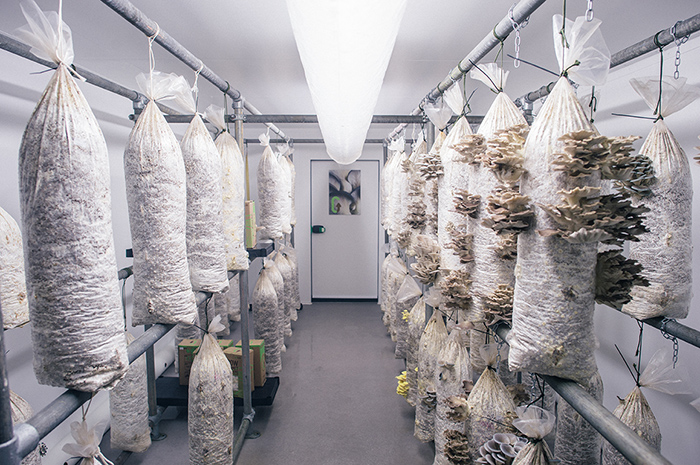
Hope this helps a little for now.
Best wishes,
Adam
AdamYeah if you’re outside the US or Europe I can imagine it could be difficult to source the spawn easily, so making it yourself is a great way to go.
When we buy grain spawn in bulk it costs £2.5 per kg, so that’s approximately US$2 per lb
Cheers,
Adam
AdamHi Robert,
Which country are you in? If in the UK, you could try Mushroom Box who I believe sell 1kg bags of Oyster mushroom spawn which is about what you would need:
http://mushroombox.co.uk/index.php?main_page=product_info&cPath=12&products_id=95
Best wishes, Adam
AdamRobert asked:
—————-
Hi there. I have looked at the info on where to buy spawn but seem to have no luck in actually buying any. I either have to buy far more thanIi need or I cant find a site with a price on it .
All I want is some winter oyster muchroom spawn enough for 5 kg of coffee ( obviously there would be some left over ). Please help . Thank you
—————-
AdamHi Bill,
yes using grounds which are more than 48 hours old (and even more than 24 hours old during the warmer summer months) will defintiely increase your instances of green mould.
I’m not sure on the effectiveness of pasteurising grounds by microwave – my feeling is that if mould has already begun to develop (this may be hard to see at first) then it would probably not be a very effective way to kill it off. Only a full sterilisation at 121C would guarantee killing it.
With regards pasteurising straw – the best method is cold water pasteursing in a lime water bath, documented in the additional resources of module 3 inside the course.
Hope this helps.
Best wishes, Adam
AdamBill Asked:
——————
Hi Adam and Eric,
I have some problems with green mould at times, this has been improved as I’ve mixed substrate other than coffee into the mix. As I have to sometimes do large mixes due to our requirements, I think some of the coffee grounds I collect has been around a bit too long and so not as pasteurised as I would like. I have seen a few things online that coffee grounds can be pasteurised in a microwave oven, is this advisable? Also, what in anyone’s opinion is the best method for pasteurising straw?
Bill Simpson
People and Gardens CIC
————————–
AdamHi Mateo,
Great that you’re interested to delve deeper into culture work – I’m sure some people here will find it useful. As you said this kind of stuff is covered well elsewhere on forums like the Shroomery, Mykotek and Mycotopia, where there are hundreds of options and different ways of doing things.
Our approach, based on quite a bit of experience of teaching and working with other organisations interested in growing mushrooms on coffee, is that most people just want to have success and grow in the simplest way possible. That means no pressure cookers, a sterile working environment and 3 stages of expanding a culture into spawn before adding it to the coffee. Just add good quality spawn to a balanced coffee-based substrate and focus on growing the mushrooms well.
Fair play to you though for getting into the more skilled side of mycology – let us know how you get on.
All the best,
Adam